Iran War: Museveni tells Middle East to learn from Uganda’s past mistakes
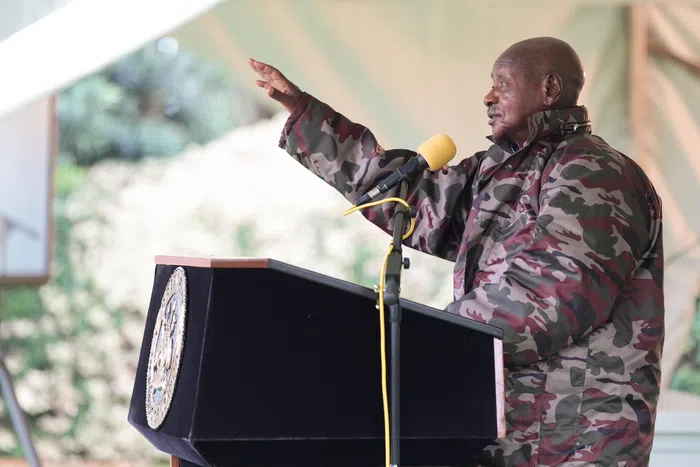
Museveni was speaking at the State House Iftar dinner which was graced by Iran’s ambassador to Uganda, Majid Saffar, who earlier in the day had urged Uganda, in its role as chair of NAM, to publicly address the invasion of Iran by the United States and Israel.
Yoweri Museveni has called on the leaders in the Middle East to draw lessons from Uganda’s own turbulent political history, warning that sectarian and identity-based politics risk deepening the ongoing crisis surrounding Iran and Israel.

Speaking Thursday night during an Iftar dinner hosted for Ugandan Muslims at State House in Entebbe, the Ugandan president, and sitting chairman of the Non-Aligned Movement, said the escalating tensions involving Iran, Israel and the United States mirror the kind of divisive politics that once plunged Uganda into decades of instability.
The dinner was attended by scores of Ugandan Muslims and also graced by Iran’s ambassador to Uganda, Majid Saffar, who earlier in the day had urged Uganda, in its role as chair of NAM, to publicly address the invasion of Iran by the United States and Israel.
Museveni said he has privately engaged leaders across the Middle East over the years, including Israeli Prime Minister Benjamin Netanyahu and former Iranian presidents Mahmoud Ahmadinejad, Ebrahim Raisi and Akbar Hashemi Rafsanjani.
According to Museveni, the root of the conflict lies in what he called “chauvinism,” different groups view themselves as more important than others.
The whole problem starts with what we call chauvinism when everybody thinks they are the most important. You can now see the destruction taking place,” he said.
Museveni said he had previously urged Iranian leaders to recognise Israel as a sovereign state to pave the way for a two-state solution to the long-standing Israeli-Palestinian conflict.
He argued that Jews, Persians, Medians and Palestinians all historically belong to the Middle East.
At the same time, he said he challenged Netanyahu over Israel’s reluctance to fully embrace the two-state solution, while also questioning Washington’s reliance on military force in the region.
Drawing parallels with Uganda’s political past, Museveni said the country nearly collapsed because early post-independence politics revolved around identity rather than shared national interests.
He cited Uganda’s 1962 elections, when parties such as Democratic Party, Uganda People’s Congress and Kabaka Yekka mobilised supporters along religious, regional and ethnic lines.
“That was the poison that almost destroyed Uganda,” he said, adding that the resulting instability fuelled cycles of conflict from the 1960s through the 1980s.
“That was the poison that almost destroyed Uganda. None of them could win a majority and we went into war up to from then through the 1980s”

Museveni said Uganda eventually overcame this crisis after reform movements promoted what he called the “politics of interests” rather than identity-based mobilisation.
When you see the suffering in the Middle East, these are consequences of the politics of identity,” he said.
The president also called on global powers to prioritize economic cooperation and prosperity instead of conflict, arguing that shared growth benefits all nations.
About The Author