ECO CONSERVATION TRUST CELEBRATES 27 YEARS OF EXISTENCE
Otai James
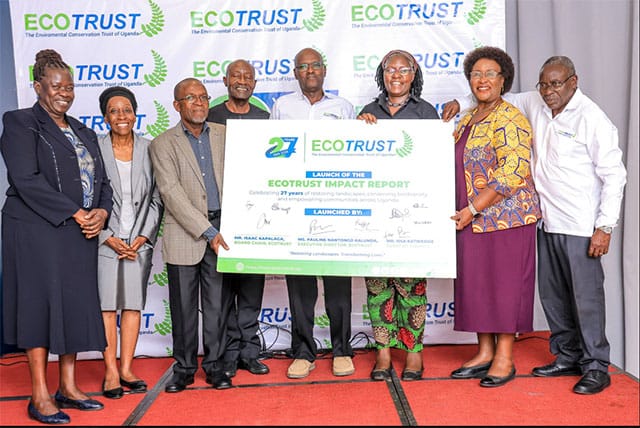
Environmental Conservation Trust of Uganda (ECOTRUST) has launched a series of activities to mark 27 years of promoting conservation financing, biodiversity restoration, and sustainable livelihoods in Uganda.
Executive Director,Eco trust Uganda,Pauline Nantongo Kalunda,while addressing participants in kampala recently said the celebrations will highlight nearly three decades of the organization’s contribution to environmental conservation and support for rural smallholder communities across the country.
“Twenty-seven years is a significant milestone for any institution, especially in a sector where many organizations struggle to survive beyond their early years,” Nantongo said.
“Our work has always focused on ensuring that conservation is not only environmentally important, but also economically meaningful for local communities,” she added.
The organisation
founded in 1999 following the transformation of a former environmental grants management unit supported by the United States Agency for International Development (USAID), ECOTRUST was established with the mission of conserving biological diversity while improving social welfare through sustainable environmental management.
Nantongo said one of the organization’s flagship initiatives is the “Trees for Global Benefits” programme, launched in 2003 and regarded as one of Africa’s earliest cooperative carbon offset schemes.
The programme connects Ugandan smallholder farmers to voluntary carbon markets while promoting sustainable land restoration and improved livelihoods.
The Environmental Conservation Trust of Uganda (ECOTRUST) is a not-for-profit conservation organization established in Uganda in 1999 to conserve biological diversity and enhance social welfare by promoting innovative and sustainable environmental management.
We deliver conservation finance “where it matters most” – to thousands of smallholders undertaking restoration as a business in rural communities. We deploy conservation incentives in ways that enable ECOTRUST to consider investments that others can’t.
About The Author